
Where do we stand in carbon management policy in Germany and the EU?
Since the beginning of 2023 at the latest, the discussion in Germany and the EU has been picking up speed. At mid-year, an overview of relevant political processes, the state of the debate and recommendations for action.
First: The confusion over key terms continues. A large number of actors are confusing CCS/CCU/CDR. The umbrella term carbon management fuels this. It is important to note: “CCS/CCU in industry” does not have the same strategic role in climate policy as “CO2 removal” (details here: https://lnkd.in/eTyJWn59).
The political initiatives of the German government and at EU level are more differentiated than the debate. Two pillars of carbon management policy are emerging – one for “CCS/CCU in industry”, one for “CO2 removal”. The diagram shows an overview of the 3 processes that are most important in my opinion.
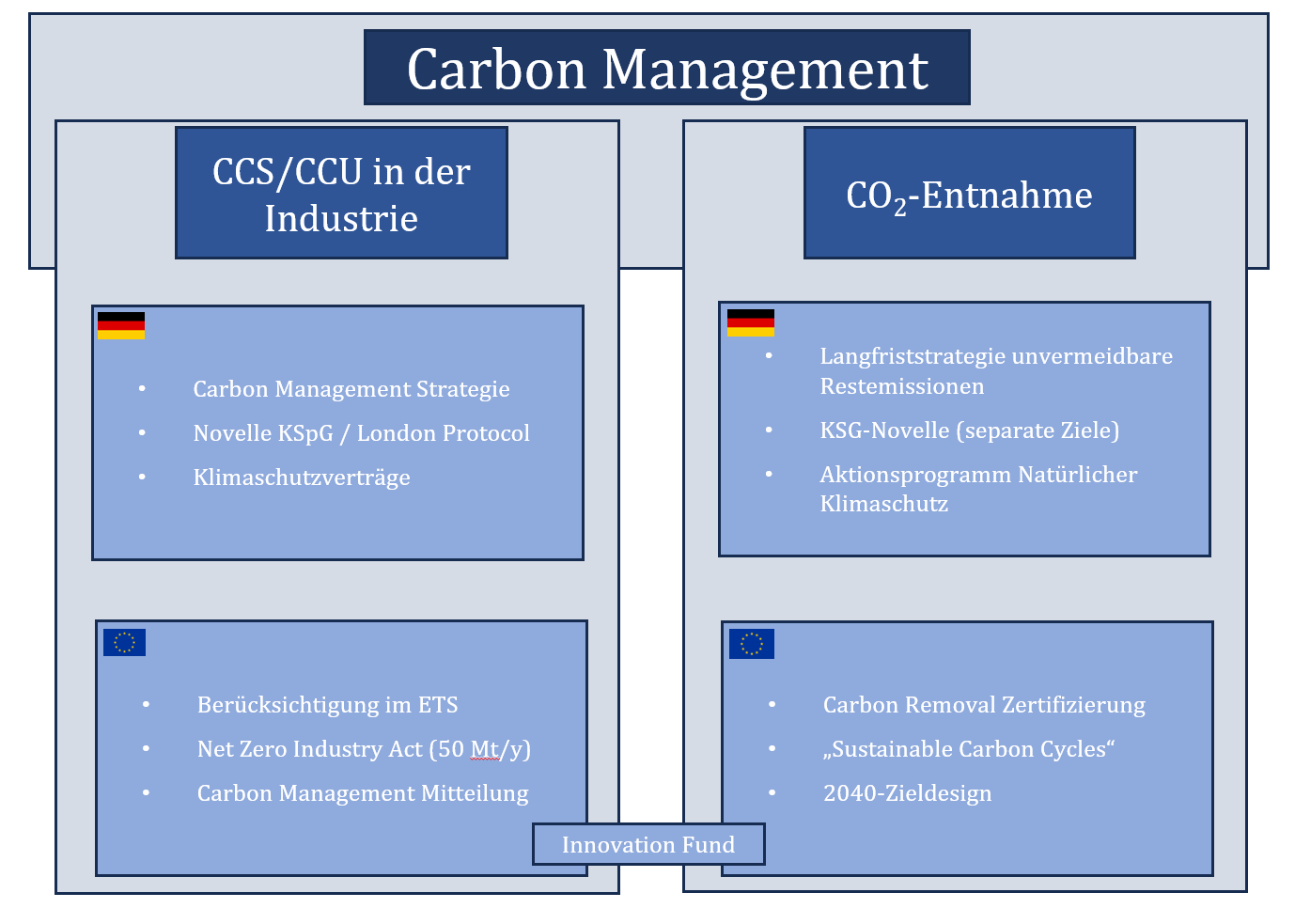
In all of this, the following applies: Initiatives at German and European level have overlaps and influence each other. Above all, the 2040 target and the reforms of all central instruments (ETS/ESR/LULUCF) will
significantly shape German climate policy – not only in questions of carbon management.
What are the next steps? 4 points that are important in carbon management policy for the coming months.
1️⃣ Create clarity in terms: Lack of precision leads to confusion and creates mistrust about the policy objectives being pursued.
2️⃣ Implement the priority of emission reduction: If emission reductions without CCS/CCU are a priority – as almost every political actor communicates – corresponding political decisions are needed; e.g. an upper limit of emission reductions that may be achieved with CCS/CCU.
3️⃣ The same applies to CO2 removal: if emission reduction is to take precedence over CO2 removal, separate targets must be adopted here. The EU’s 2040 target points in this direction and would be an opportunity – as would the amendment of the KSG.
4️⃣”Carbon Management Taxonomy: Clarify which CCS/CCU applications are considered ‘legitimate’. Investment cycles are too long & risks too high to leave this unclear. This could create investment certainty for companies & trust for critics of these technologies.
 Felix Schenuit