
The EU Commission proposed the Net Zero Industry Act on 16 March in response to new industrial policy initiatives in the US (the Inflation Reduction Act, IRA) and other countries such as Japan (green transition bonds), India (Production Linked Incentive Scheme) and others.

A key element of the new proposal concerns “carbon management”. The Commission wants to set a “CO2 injection capacity target” of at least 50 Mt per year in the EU by 2030. This target is expected to have a major impact on the carbon capture and storage (CCS) debate in EU Member States in the coming months. Whether this will lead to an increase in CCS activities or a more polarised debate on whether CCS is a legitimate part of climate change mitigation strategies remains to be seen.
CCS as strategic net zero technology
CCS technologies are now part of the set of “strategic net zero technologies” that the EU Commission wants to support. Earlier versions of the document used the term “CCUS”, but advocates of carbon capture and use (CCU) lost the framing battle.(for insights from the first leak, see this Twitter thread).
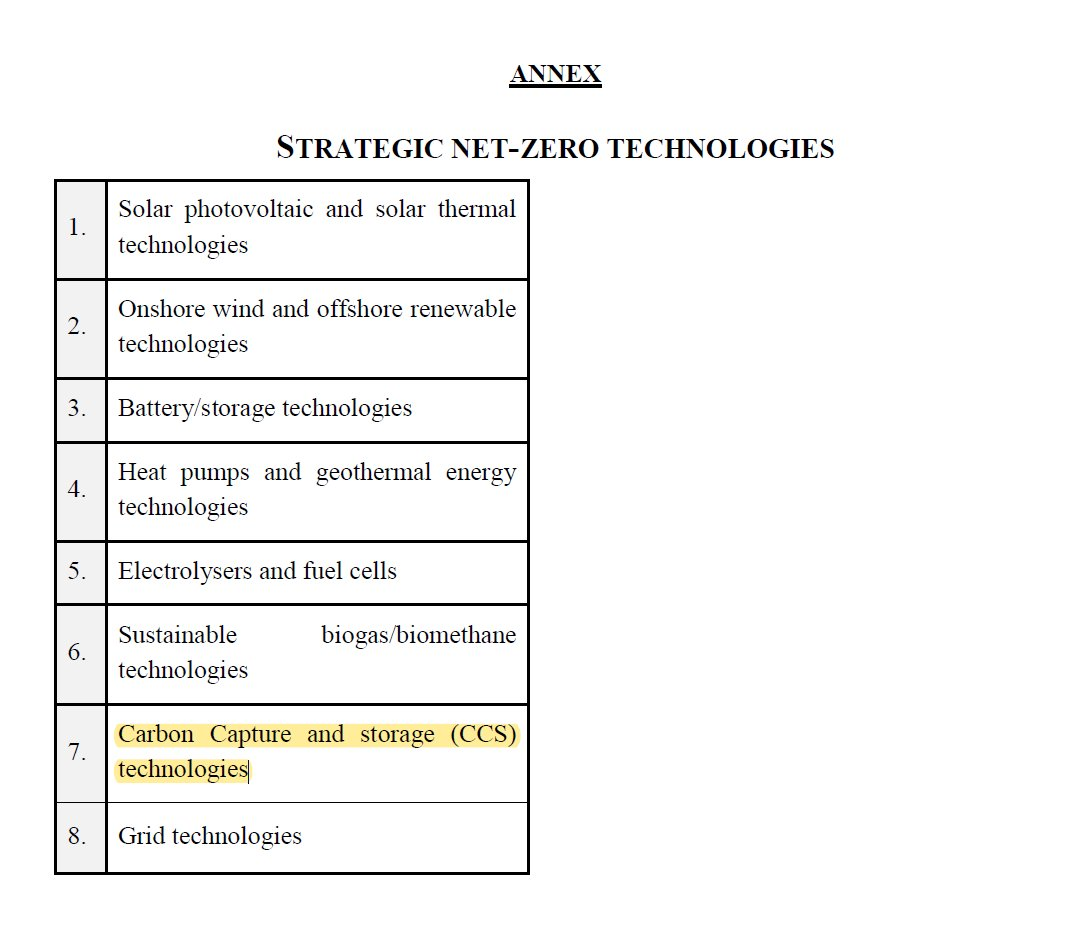
It’s important to note that the proposal highlights the import dependency for most of the other technologies on the list, while CCS faces the issue of a lack of storage sites within the EU. The Commission aims to solve this with the new “injection capacity target.”
Initially, the wording from a leak stated that CCS would be needed to “assist the power sector in achieving climate neutrality or net-zero with carbon removals,” but this was removed from the final proposal due to potential controversy. The definition of the capacity target also shifted from “energy-intensive and hard-to-abate industries” to “reducing emissions or increasing carbon removals, particularly from large industrial installations.”
To qualify as a “net zero strategic project” under the Net Zero Industry Act, a CCS project must meet three criteria: 1) located in the EU territory, 2) contributing to the 50Mt/year target, and 3) applied for a permit under the CCS Regulation.

Targets for oil and gas producers
Oil and gas producers have a special role to play in achieving the capacity target, according to the proposal. They “have the assets, resources and skills to enable this capacity” and “are able to find the most cost-effective projects” by working together. The proposal also identifies a “coordination failure” for CCS, where high ETS prices incentivise investment but industry faces risks in terms of permitted geological storage sites and associated upfront costs. One solution is transparency on storage capacity.
The legislation proposes an individual contribution to the injection capacity target for oil and gas companies in Europe. They will have to submit plans on how they will meet their contribution, will be allowed to cooperate with others to meet it, and will have to submit annual progress reports. Member States must also provide information on storage sites and the status of CCS permitting and deployment.

What role for the Innovation Fund?
An interesting element that was part of the leaks but is not in the final proposal: It seems that the link to the EU’s Innovation Fund was controversial within the Commission. While the first leak proposed to “mobilise” the Innovation Fund and the second promised Auction Platforms, the final proposal removed the article on this altogether. As Member States are expected to be interested in channelling money from the recently increased Innovation Fund into their potential new CCS project, this could be something that is reintroduced into the regulation during the legislative process.
Conclusion and next steps
The fact that the Net Zero Industry Act proposes a target for CO2 injection capacity is an important step in the EU’s carbon management policy. The Commission’s efforts to put it on the agenda will facilitate the debate and could indeed improve knowledge of storage sites for CCS in the EU. However, the regulation does not say for what purposes CCS should be developed. As this is a controversial issue, at least in some Member States, and as countries differ widely in whether and how they proactively deal with CCS, the new target will trigger lively debate at the interface of climate and industrial policy.
For more details from the proposal, see this Twitter thread.
 Felix Schenuit